 Preview this Title
Book Descriptions
for Whale Eyes by Alan James Robinson and Brian Rea
From Cooperative Children's Book Center (CCBC)
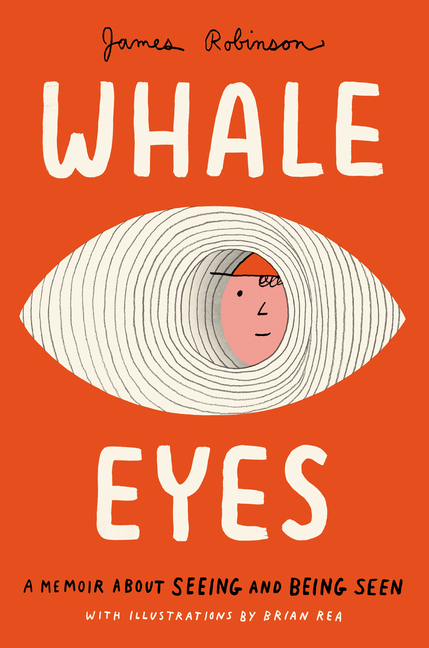
James Robinson was born with a vision impairment called anomalous retinal correspondence, a type of strabismus that means his eyes rapidly take turns looking straight ahead. “Whale eyes,” he calls it. In this outstanding memoir, James uses a highly original, interactive format to help the reader understand the way in which text appears to jump about the page when he reads, and how the red dots and white boxes of vision tests never seem to meet. At school, James simply pretended to read; he felt humiliated by classmates’ staring and the extra time he needed to finish exams. He knew people were uncomfortable making eye contact with him. Eventually homeschooled by his mom, who used teaching techniques uniquely suited to his needs, he thrived academically and developed an interest in documentary filmmaking. Observing that eyes like his appear in pop culture as a “visual cue” that indicates a character is “disconnected from reality,” “evil,” or “unintelligent,” he made a short film explaining his condition, which was eventually published in the New York Times and led to his making additional films on difficult-to-explain disabilities. His documentary has a purpose—to make the audience care about disability and disabled people—and James here provides clear tips on how to tell a story, or communicate an experience, effectively. James’s compassion, good humor, and ability to clearly explain a complicated condition are remarkable.
CCBC Choices 2026. © Cooperative Children's Book Center, Univ. of Wisconsin – Madison, 2026. Used with permission.
From the Publisher
From Emmy Award–winning documentary filmmaker James Robinson comes a breathtaking illustrated memoir for readers ages 10 and up—inspired by the viral, Emmy-nominated short film Whale Eyes.
WINNER OF THE SCHNEIDER FAMILY BOOK AWARD • AN ORBIS PICTUS RECOMMENDED BOOK • A BEST BOOK THE YEAR: School Library Journal, NPR, BCCB, New York Public Library, and Chicago Public Library
Told through an experimental mix of intimate anecdotes and interactive visuals, this book immerses readers in James’s experiences growing up with strabismus, allowing them to see the world through one eye at a time.
Readers will get lost as they chase words. They’ll stare into this book while taking a vision test. They’ll hold it upside down as they practice “pretend-reading”…and they’ll follow an unlikely trail toward discovering the power of words.
With poignant illustrations by Eisner Award–nominated artist Brian Rea, James’s story equips readers of all ages with the tools to confront their discomfort with disability and turn confused, blank stares into powerful connections.
WINNER OF THE SCHNEIDER FAMILY BOOK AWARD • AN ORBIS PICTUS RECOMMENDED BOOK • A BEST BOOK THE YEAR: School Library Journal, NPR, BCCB, New York Public Library, and Chicago Public Library
Told through an experimental mix of intimate anecdotes and interactive visuals, this book immerses readers in James’s experiences growing up with strabismus, allowing them to see the world through one eye at a time.
Readers will get lost as they chase words. They’ll stare into this book while taking a vision test. They’ll hold it upside down as they practice “pretend-reading”…and they’ll follow an unlikely trail toward discovering the power of words.
With poignant illustrations by Eisner Award–nominated artist Brian Rea, James’s story equips readers of all ages with the tools to confront their discomfort with disability and turn confused, blank stares into powerful connections.
Publisher description retrieved from Google Books.
